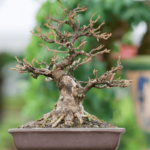
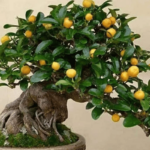
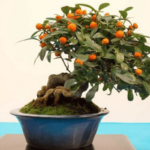
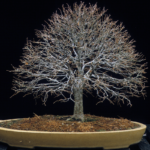
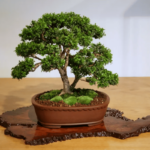
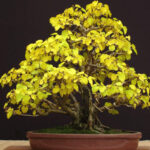
The jabuticaba bonsai (also spelled jaboticaba) is one of the most popular fruit bonsai among growers.
This plant is easy to grow and very beautiful.
So, if you want to learn how to grow this type of bonsai, read this article until the end.
Characteristics of the jabuticaba bonsai

Native to southeastern Brazil, the jabuticaba tree bears sweet, round fruits that grow directly on its trunk and branches.
In its natural habitat, a jabuticaba tree can reach up to 15 m (50 ft) in height, and it can live for more than 100 years.
Some curiosities:
- Jabuticaba flowers and fruits grow directly on the trunk and branches, a trait called cauliflory. This is where the name cauliflora comes from.
- A seed-grown tree can take 10 to 15 years or more to produce its first fruits, so it’s best to start with a grafted or air-layered plant, which bears fruit much sooner.
- There’s a myth that jabuticaba bonsai don’t bear fruit, but that’s false.
For your jabuticaba tree to bear fruit, whether in nature or as a bonsai, you need to grow it correctly.
This is why you should follow the step-by-step guide below to learn how to take care of your jabuticaba bonsai.
How to grow a jabuticaba bonsai

Scientifically known as Plinia cauliflora (formerly Myrciaria cauliflora), jabuticaba trees are excellent options for beginner bonsai growers.
In addition to being very rewarding to grow, they are also quite resilient.
However, like any other plant, they require some special care. Below are some tips that will help you when growing your jabuticaba bonsai.
1 – Placement
Jabuticaba trees should be grown outdoors if you live in tropical regions where the winter is not very harsh.
In regions where winter temperatures drop below 10°C (50°F), it’s recommended that during this period, your jabuticaba bonsai is moved to a protected location with plenty of light.
For example, inside your home near a window.
To make the best choice for placing your jabuticaba tree, you should understand the next topic we’ll cover.
2 – Temperature and lighting
Jabuticaba is a plant native to Brazil, mainly to the southeastern part of the country.
In these areas, it’s accustomed to warmer climates and direct sunlight.
To provide optimal lighting for your jabuticaba bonsai, follow these tips:
- Direct sunlight for most of the day, except when the sun is at its hottest.
- Warmer temperatures. Very low temperatures can hinder the plant’s development, so avoid temperatures below 10°C (50°F) as much as possible.
Great options for growing this bonsai include placing it in sunny windows (during harsh winters), in a spot with direct sun and some afternoon shade, or on covered balconies.
3 – Watering

This is one of the most important factors for keeping your jabuticaba tree healthy and free from pests or diseases.
To get watering right, you need to understand that this plant goes through different periods during the year, and each of these periods requires a different amount of water.
Here’s how:
- Spring to fall (growing season): The plant is using a lot of energy to grow and develop, so water consumption is higher. Water more often and keep the soil slightly moist, especially in summer.
- Winter: Reduce watering a bit during this period.
To check if the soil of your jabuticaba bonsai has dried out, it’s very simple.
Just insert your finger about 2.5 cm (1 inch) into the soil and check if it’s still damp.
Here are other tips that can help you with watering your jabuticaba tree:
- Be very careful not to forget to water your bonsai, as the jabuticaba tree is not resistant to drought.
- If the leaves of your jabuticaba bonsai are turning yellow or falling off, it could be due to lack of watering.
- Factors like pot size, climate, humidity, and temperature influence how much watering your bonsai needs.
4 – Fertilization
There are 2 types of fertilizers you can use for your jabuticaba tree:
- Organic fertilizers
- Inorganic fertilizers
With organic fertilizers, nutrient release is slower, and you don’t risk over-fertilizing your jabuticaba tree.
With inorganic fertilizers, you have more control over which nutrients and in what quantities you provide to your plant.
Both options are great, and the choice of which to use depends on the grower’s personal preference.
When to fertilize and recommended fertilizers
Some organic fertilizers that can be used for a jabuticaba bonsai include:
- Bone meal
- Chicken manure (well composted)
- Castor bean meal
A common choice among growers is to mix castor bean meal and bone meal, applying the fertilizer every 2 months during the growing season.
Keep castor bean meal out of reach of dogs and cats, as it can be toxic if eaten.
As for the dosage, check if the product has specific recommendations for bonsai; if not, apply half of what is recommended on the packaging.
Inorganic fertilizers give you greater control over the nutrients provided to your bonsai, but remember to choose quality brands for fertilization.
In this case, fertilization is particularly important during your jabuticaba tree’s growing season, from spring to fall.
Three excellent fertilizer recommendations are:
- Fertilizers high in phosphorus (e.g., NPK 4-14-8)
- Fertilizers specifically formulated for jabuticaba trees
- Controlled-release (coated) fertilizers, which feed the plant slowly over several months
5 – Pruning

Pruning is essential for any bonsai.
For the jabuticaba tree, I’ve selected a few rules that, if followed, will ensure your pruning is well done.
These are simple yet highly effective rules:
- Cut new branches to shape the tree as desired.
- Avoid pruning during winter.
- Perform larger prunings at the beginning of spring; this will ensure your bonsai recovers quickly.
- Remove shoots that appear near the roots.
6 – Repotting
Repotting a jabuticaba bonsai usually occurs every 1 or 2 years, always in early spring.
To learn how to repot your bonsai, watch the video below:
Some important notes:
- Jabuticaba trees prefer well-draining, slightly acidic soil, with a pH between 5.5 and 6.5.
- Wait at least 1 month to fertilize your bonsai after repotting.
- Prune a maximum of 50% of the roots.
7 – Propagation
Jabuticaba bonsai can be propagated in two ways:
- Seeds
- Air layering
Propagation from seeds is a bit more labor-intensive, and it can take between 10 to 15 years to see your first fruits.
Alternatively, if you want to use air layering, choose a branch with fruits and do this at the end of winter.
8 – Wiring

Some bonsai enthusiasts do not recommend wiring jabuticaba trees.
This plant has thin, smooth bark, so if you’re not careful, the wire can leave scars on its branches.
However, if you want to wire, leave the wire in place for 2 to 3 months and check it every few weeks.
If the wire starts to cut into the bark, remove it right away, even if the branch hasn’t set in its new shape yet.
9 – Pests
Jabuticaba is a very resilient plant, so you’re unlikely to encounter significant issues with pests and diseases in bonsai.
However, as the saying goes, prevention is better than cure.
Some of the main pests that attack jabuticaba trees include:
- Red spider mites
- Scales
- Aphids
- Nematodes
Regularly check your bonsai for problems. If you spot pests, treat them early with insecticidal soap or neem oil.
Conclusion
I hope that with this article, you’ve learned a bit more about one of the most popular bonsai in Brazil, the jabuticaba bonsai.
If you want to learn more about bonsai, check out the articles below:
- Orange Bonsai – How to Easily Cultivate and Care Without Any Difficulty
- Boxwood Bonsai (Buxus) – Step-by-Step Care Guide
- Lemon Bonsai – Discover How to Cultivate Them Easily
- Pomegranate Bonsai – How to Care in 6 Simple Steps
- Mulberry Bonsai – How to Care in 7 Steps
Now it’s your turn! Help us teach more people how to grow their plants.
Click on the buttons below and share this article on your social networks, as it greatly helps us.