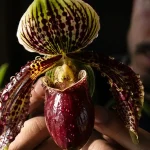
You know those gorgeous orchids you see at the entrance of some grocery stores? They’re called Phalaenopsis, also known as moth orchids.
Maybe this has happened to you…
- You walk into the store
- You see the orchid and fall in love
- You buy one and take it home
- It looks beautiful for weeks
- You show it off to everyone who stops by, and at some point the flowers fall off
Then the question hits: was that it? Did the plant die?
It didn’t.
And there’s a good chance it produced fewer flowers than it was capable of.
A single Phalaenopsis flower spike can produce anywhere from 3 to 40 flowers.
Together, they can stay open for up to 3 months, depending on the variety, the temperature, and the care you give them.
In this article, you’ll learn how to get the most flowers out of your orchid!
Learn How to Achieve Super Blooms on Your Orchids
➜ YES, I WANT TO LEARNThe trick of the flowers that take turns
Many people believe that Phalaenopsis flowers, or those of other orchids, all open at once, but that’s a myth.
The ones closest to the base of the spike open first.
Then the rest gradually open, working their way toward the tip.


And that’s exactly what extends the time your orchid stays in bloom.
While the first flowers are already wilting, the ones at the top may not have even opened yet.
It’s as if the plant were managing its own show so it doesn’t end in the first act.
An extreme example of this is the species Phalaenopsis kapuasensis, which can produce more than 30 flowers on a single inflorescence, but only 2 to 10 are open at the same time.
In other words, when you count the open flowers in the pot, you’re seeing a snapshot, not the full total.
Think 30 flowers is a lot?
Some species, such as Phalaenopsis schilleriana and Phalaenopsis philippinensis, can produce more than 100 flowers per spike, according to Wikipedia.

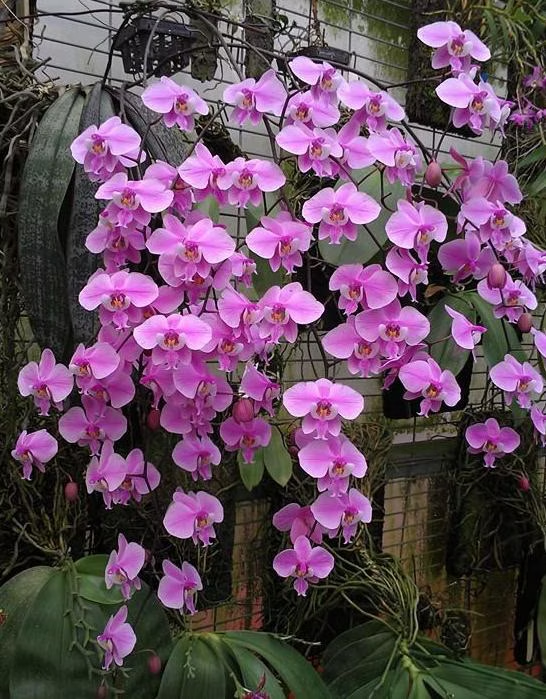
These are a bit harder to find at the grocery store (see the photos above).
Why does yours produce 8 flowers while the nursery’s produces 30?
In commercial nurseries, flowers are more abundant because everything is controlled:
- Light
- Humidity
- Watering
- Fertilizing
Among other factors. At home, replicating all of that with precision is very hard.
Even so, there are a few techniques you can use to increase the number of flowers.
The first is to improve how you grow your orchid, and for that, I recommend you check our guide.
Second, stop looking only at the spike and focus on the plant’s growth.
Larger and more numerous leaves work like solar panels. They store energy for your orchid, and that reserve is what supports better blooms in the following years.


A Phalaenopsis with four large, firm leaves is more likely to give you 20 flowers than one with two limp leaves and lots of fertilizer.
The cold factor
Another important tip, already explained in our article “What science discovered about how Phalaenopsis orchids bloom“, is the importance of temperature changes.
Cold is essential for your Phalaenopsis to produce flower spikes. That’s why nights between 13°C and 18°C (55°F to 64°F), sustained for several weeks in the fall, are the trigger that usually sets off a new flower spike.
In practice, this means that porch or balcony that gets chilly at night in the fall may be the best spot in the house for your orchid during that time.
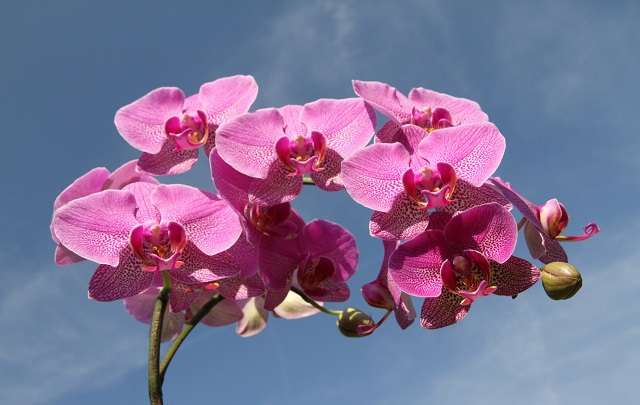
One more important tip: if you want a second bloom in the same year, once the flowers fall, cut the spike just above the third node, counting from the bottom up. As we explained in our article on flower spikes, doing this can trigger a secondary spike within 8 to 12 weeks.
If the plant is weak, with limp leaves or few roots, do the opposite: cut the spike about 5 centimeters (2 inches) from the base and let it build up energy for the following year.